Covid-19 apparently is responsible for many cancers dangerously advancing, physicians have warned, because the pandemic caused a large drop in screenings.
![]() |
| Dr. Patrick Borgen |
![]() |
| Dr. Barbara L. McAneny |
Covid-19 apparently is responsible for many cancers dangerously advancing, physicians have warned, because the pandemic caused a large drop in screenings.
![]() |
| Dr. Patrick Borgen |
![]() |
| Dr. Barbara L. McAneny |
| Joe Marciniak self-portrait |
Will AI be able to transform the mammogram and "allow patients to avoid aggressive treatments and even save the lives of countless people who get breast cancer"?
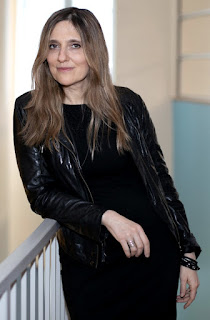
| Professor Regina Barzilay |
The Post article reports that Barzilay and Adam Yala, a student protege, "have built an AI that seems able to predict with unprecedented accuracy whether a healthy person will get breast cancer, in an innovation that could seriously disrupt how we think about the disease."
How it works was laid out in an piece in the Journal of Clinical Oncology: "By analyzing a mammogram's set of byzantine pixels and then cross-referencing them with thousands of older mammograms, the AI — known as Mirai — can product nearly half of all incidences of breast cancer up to five years before they happen."
"If the data is validated, I think this is very exciting," Zeitchik's story quotes Janine T. Katzen, radiologist at Weill Cornell Medicine who specializes in breast imaging. It also quotes Dorraya El-Ashry, chief scientific officer for the Breast Cancer Research Foundation, as saying, "This is the next, very positive step forward. There is a lot of work to do. But this is very encouraging."
Meanwhile, breast cancer statistics are discouraging. "While many cancers, such as lung cancer, have been declining in the United States," the Post story says, "breast cancer rates have been going up — an annual average of half a percentage point between 2008 and 2017, according to the American Cancer Society."
More information on out-of-the-ordinary treatments can be found in "Rollercoaster: How a man can survive his partner's breast cancer," a VitalityPress book that I, Woody Weingarten, aimed at caregivers.
Monsanto has challenged a $25.2 million award to a cancer patient.
![]() |
| Edwin Hardeman |
The basis of the claim by Bayer, Monsanto's parent company, is that the U.S. Environmental Protection Agency (EPA) had concluded that the herbicide, the world's most widely used, was safe.
However, an arm of the World Health Organization (WHO), the International Agency for Research on Cancer, had concluded in 2015, that the main ingredient in Roundup, glyphosate, "was a probable cause of human cancer, a finding endorsed by California health officials," the Chronicle piece says.
The court is expected to consider the appeal at its weekly conference Dec. 10.
Monsanto filed the appeal despite it agreeing to replace glyphosate "with another active ingredient for U.S. home and garden sales, starting in 2023, while continuing to market the current version for agricultural use," Egelko's story reports.
The Ninth U.S. Circuit Court of Appeals, in a May ruling that upheld Hardeman's damage award, "said the EPA's approval did not carry the force of law, and it did not preclude a judge or jury from deciding whether Monsanto had violated a California law requiring warnings against risks that are 'known or knowable.'"
Hardeman was diagnosed with lymphoma, a sometimes fatal disease, in 2015 after having used Roundup for 26 years on properties in Galla and Santa Rosa.
A federal court jury in July 2019 found the weed-killer was a "substantial cause" of his cancer. It awarded him, according to Egelko's story, "damages for economic losses, pain and suffering and emotional distress, along with punitive damages against the company for selling a product it knew, or should have known, to be dangerous."
The article also notes that "state courts, meanwhile, have upheld damages of $21.5 million to Dewayne 'Lee' Johnson, diagnosed with terminal cancer after spraying the herbicide as a groundskeeper for the Benicia Unified School District, and $82.2 million to Alva and Alberta Pilliod of Livermore, who sprayed Roundup on their crops for 30 years."
More information about consumer products that may cause disease can be found in "Rollercoaster: How a man can survive his partner's breast cancer," a VitalityPress book that I, Woody Weingarten, aimed at male caregivers.
It’s been five years since I, Woody Weingarten, and my granddaughter, Hannah Schifrin, close despite a 70-year difference, finished co-writing "Grampy and His Fairyzona Playmates.” But we had to wait for the marvelous full-color illustrations to be done — and 2,149 tweaks.
The fantasy, aimed hat 6 to 10-year-olds, is now available from Amazon, Apple, Barnes & Nobel and a bunch of other places. You can check out what it's all about on my new website — http://woodyweingarten.com.
The book tells of a sorcerer who frequently must get his granddaughter Lily and her best friend Penny out of trouble when the two eight-year-old fairies mess up their magic spells.
Readers willing to let their imaginations run wild can learn about winning a division of the Unicorn Racing Championships, baby chicks that sing jazz instead of cheeping, a wizard who can make robot movie characters less scary, and two girls who want to stop “all the thunder-and-lightning storms, floods, earthquakes and tornadoes all over the planet.”
And — you can bet on it — more, much more.
![]() |
| Dr. Peter Hulick |
Oscar-winning actor Jeff Bridges says his getting Covid made his lymph-system cancer seem like "a piece of cake."
According to recent online HuffPost story by Mary Papenfuss, Bridges — who survived has both the virus and the lymphoma, which is now in remission — thought he was "gettin' close to the pearly gates."
![]() |
| Jeff Bridges, wife and Oscar |
The pandemic, Papenfuss' article states, caused him "moments of tremendous pain" causing him to cry out "throughout the night."
Extra oxygen reportedly was necessary for the actor to just walk around. The HuffPost story quotes Bridges as saying the sound of reminded him "of Darth Vader."
Covid-19, the HuffPost piece quotes the mid-September Bridges website post, "kicked my ass pretty good, but I'm double vaccinated and feeling much better."
The vaccine, he suggested, was linked to his speedy improvement, with all his treatments now being "in the rearview mirror."
Bridges, who won the best actor Oscar in 2010 for "Crazy Heart" and had been nominated for half a dozen other Academy Awards, had been hospitalized for five weeks, he wrote, because his immune system was "shot from chemo."
His wife, Susan Geston, not incidentally, also was hospitalized — although only for five days — because she contracted Covid.
Bridges was elated, he indicated, to be released in time to walk Hayley, his daughter, down the aisle for her wedding and to dance with her "without oxygen."
More information about disease treatments can be found in "Rollercoaster: How a man can survive his partner's breast cancer," a VitalityPress book that I, Woody Weingarten, aimed at male caregivers.